

Happy STEM Day! While at talkSTEM, we believe every day is a STEM day, November 8th is a particularly perfect opportunity to put on your STEM lens and notice the science and math around you (and maybe even post about it on our Instagram). It’s also a chance for talkSTEM to reflect on all that we’ve accomplished over the past year — sort of like our STEM New Year! Here are some highlights!
This past year, we partnered with Savvas Learning Company on their K-12 Envision+ Math program. With our creative partner Hello SciCom, talkSTEM wrote and produced over 50 math walk videos that introduced different math concepts to K-12 students while staying true to our methods of posing observation-based questions situated in real world environments. We also partnered with Savvas Learning’s editorial teams to assist in the development of scripts for all math walk videos across the entire Envision+ Math program and thoroughly enjoyed the opportunity to collaborate with such a passionate and dedicated team of educators and professionals. The 150+ math walk videos that represent the outcome of our collaboration will be published in these math textbooks and appear at the beginning of chapters across the 13 grade levels, connecting math lessons to students’ everyday lives; a froyo spot, a zoo, and a zipline all become environments to introduce concepts of arithmetic, geometry, algebra, and more. Launching in 2026 in California and Texas (and piloting select districts this fall), our entertaining and informative “sketches” will reach many thousands (if not millions) of students. No talkSTEM project has ever had such a massive reach, making this a true milestone in our mission to grow STEM education.

Earlier this year, talkSTEM and SMU launched the talkSTEM/SMU AI Educational Innovator Summer Project, which uses generative AI tools to assist educators in the creation and implementation of walkSTEMs. We recruited a dozen educators from Dallas, then taught them how to use our innovative generative AI tool to quickly create and iterate a walkSTEM for any location, while adhering to rigorous and specific academic standards. This fall, our educators brought their generative AI walkSTEMs and math walks into their classrooms and began using them with their students.
The results of this pilot program have surpassed our expectations! Our AI Educational Innovator inspired greater student enthusiasm, participation, and collaboration, while making lesson planning easier and more efficient for teachers. AI-assisted walkSTEMs encourage inquiry-based exploration of the students’ environment, be it their classroom, school, or a nearby pathway or park. They inspire students to work together, brainstorming both questions and response strategies. AI tools are not like waving a magic wand, nor can they ever replace the essential work teachers and tutors do, but when used correctly, we believe AI can be a creative partner for educators that enhances the teaching and learning experience.
As Dr. Koshi Dhingra reflected, “Our goal is not to automate education but to humanize it. When teachers have the right tools, curiosity becomes contagious.”

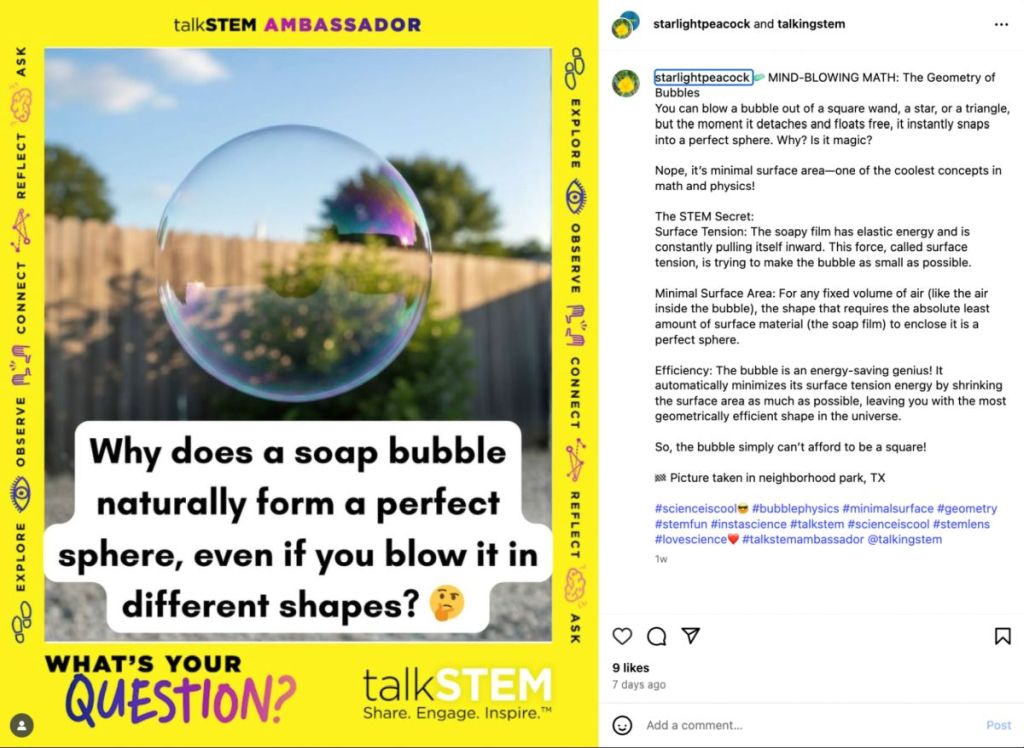
In the last few months, we launched the talkSTEM ambassador program, recruiting 20 people from all over the world to partake in the program. The only requirement? A love of STEM. These ambassadors range from high school students to college undergrads, teachers, scientists, and lifelong learners. They come from New York, Texas, Pennsylvania, Los Angeles, Jamaica, Turkey, Nigeria, and more — a true global community. What they share is a simple practice: notice the world, ask a question, and share their experience. Each week, they post one image from their environment — perhaps a playground, a sidewalk, or a skyline — and pair it with a question that reveals the hidden science, math, or engineering in everyday life.
“Sometimes STEM feels locked inside the classroom,” wrote one ambassador. “I want to help people see that it’s everywhere — in the way water spirals down a drain or how shadows move across the day.”
You can check out their posts on our Instagram here. And since it’s National STEM Day, we encourage you to follow their example and notice the math and science that’s around you. Look up from this blog post for a moment: what do you see in your room in front of you, or just out your window? When you take a walk later or run errands, what do you notice on the buildings, in the grocery store, or while stopped at a red light? STEM is all around you all the time, and when you take a moment to mindfully be aware of it, it’s incredible how naturally your curiosity engages, and how quickly your understanding of the world deepens, even just a little.
We will be recruiting a new cohort of ambassadors in the spring.
The National Science Foundation turned 75 in May, and we were honored to participate in the celebratory festivities by organizing four STEM-themed scavenger hunts. These immersive MathFinder experiences, created in partnership with SMU, took place simultaneously across four locations in Dallas: the Dallas Arboretum, the Dallas Museum of Art, the Dallas Zoo, and the Frontiers of Flight Museum. Each scavenger hunt invited participants to look at animals, art, nature, human design, and engineering through a math lens. 550 kids and adults participated in this in-person event! And you can watch the promotional video for the event here, which includes one of talkSTEM’s creative partners, Andrew Moorhead of Hello SciCom, getting hit in the face with a pancake (he would like you to know that he filmed this by himself, meaning he was actually hitting himself in the face with said pancake… anything for the NSF!).

And in speaking of the National Science Foundation… (*drumroll please*)… after a 5-year development process, talkSTEM and our partner SMU are so thrilled to announce that early next year, we will be releasing a prototype version of the MathFinder App, a powerful tool for informal STEM learning. Our app will gamify the process of experiencing and creating Math Walks, combining research-backed learning principles with an engaging storyline to get kids interested in the math concepts that are all around them.
We’ve been building the MathFinder app for years, thanks to a generous grant from the NSF, and will be releasing this version of the app on the App store for free. At talkSTEM, we believe in breaking down barriers to STEM education, and providing students with fun, free, innovative technology is a big way we can do that. The MathFinder game can be played alone by children in grades 3 and up. We anticipate it will be used in varied settings from small groups with a parent or other adult leader to summer camps and after school programs. You can read more about the MathFinder app here, and stay tuned for our official launch in the coming months!
Follow talkSTEM on social media to stay updated and join our community!